
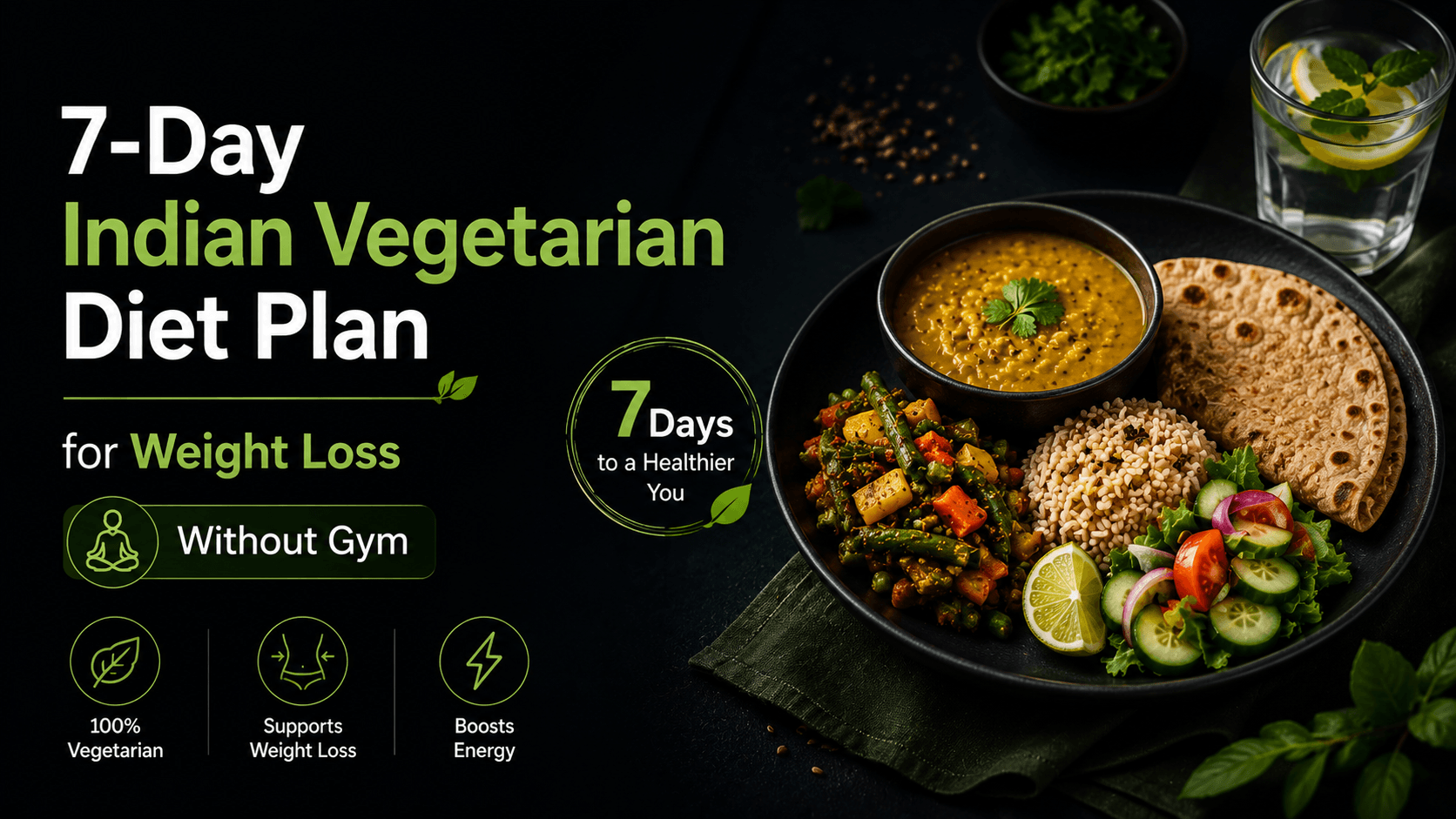
7-Day Indian Vegetarian Diet Plan for Weight Loss Without Gym
Every January, millions of Indians Google the same thing: "how to lose weight at home." And every January, most of them land on a plan that involves quinoa, avocado toast, or a gym membership they will use twice.
This is not that plan.
This is a proper Indian vegetarian diet plan for weight loss built around dal, roti, sabzi, chaas, and the actual food your kitchen already has. No gym. No expensive supplements. No giving up chai.
Just smart portion control, the right food combinations, and a 7-day meal chart you can actually follow.
0.5–1 kg
Realistic loss in 7 days
1,200
Target calories per day
5
Meals/day (no skipping)
3L
Water target daily
Before You Start
This plan is designed for healthy adults. If you have diabetes, thyroid issues, PCOS, or any chronic condition, please consult your doctor or a registered dietitian before making significant dietary changes.
Why Indian Vegetarian Food is Actually Great for Weight Loss
There is a common myth that vegetarian food does not have enough protein for fat loss. That is not true for Indian cuisine. Dal, rajma, chana, paneer, curd, sprouts, soy these are all high-protein, high-fibre foods that keep you full and protect muscle while you lose fat.
Indian vegetarian sources such as dals, legumes, tofu, paneer, soy, and whole grains are rich in protein and fibre, which are key to successful weight loss protein preserves lean muscle mass and reduces appetite, while fibre supports digestion and promotes satiety.
The problem is not the food. It is the portions and the cooking method. Deep-fried anything, maida-based snacks, too much ghee, too much rice those are the real culprits. Fix those, and Indian food becomes one of the best possible diets for sustainable fat loss.
The 5 Fat Loss Rules That Run This Plan
01 Calorie Deficit, Not Starvation
Eat 1,200–1,400 calories/day. Enough to lose fat, not enough to lose energy or muscle.
02 Protein at Every Meal
Dal, curd, paneer, sprouts, or eggs at every meal. Protein keeps you full and burns more calories digesting.
03 No Cold Water, No Soda
Drink warm water. It supports digestion and reduces bloating. Cold drinks and soda slow down your Agni.
04 Roti Over Rice (Mostly)
Whole wheat roti has more fibre than white rice. 2 rotis will keep you fuller than 1 cup of white rice for longer.
05 Eat 5 Times a Day
Three main meals plus two small snacks. This keeps blood sugar stable and prevents overeating at dinner.
06 Walk 20–30 Minutes Daily
No gym needed. A brisk post-meal walk is all the exercise this plan requires. Consistent, not intense.
The 7-Day Indian Vegetarian Diet Plan
Each day targets approximately 1,200 to 1,400 calories. Click any day to see the full meal plan. All meals use common Indian ingredients and take under 20 minutes to prepare.
Wake Up1 glass warm water with lemon and 1 tsp honey
Breakfast2 moong dal chillas with green chutney + 1 cup green tea (no sugar)
~280 cal | High protein, low carb
Mid-Morning1 medium apple or 1 cup papaya
~80 cal
Lunch2 whole wheat rotis + 1 bowl mixed vegetable sabzi + 1 bowl moong dal + 1 cup curd (no sugar)
~480 cal | Balanced macros
Evening1 cup chaas (buttermilk with jeera) + 10 roasted chana
~120 cal
Dinner1 bowl palak dal + 1 whole wheat roti + cucumber and tomato salad with lemon
~300 cal | Light but filling
Pro Tip: Open all 7 days and screenshot or print the full plan before you grocery shop.
Most people fail diets not because they lack willpower, but because the right food is not in the house when hunger hits.
Foods to Eat and Avoid on This Indian Diet Plan for Weight Loss
|
Category |
EAT FREELY |
LIMIT OR AVOID |
|
Grains |
Whole wheat roti, brown rice, oats, ragi, daliya, millets |
Maida, white bread, puri, paratha with excess ghee, white rice in excess |
|
Proteins |
Dal, rajma, chana, sprouts, paneer (low-fat), curd, soy |
Fried paneer, full-fat cream-based curries |
|
Vegetables |
All sabzis (steamed or light saute), leafy greens, lauki, tinda, turai |
Deep-fried vegetables, vegetables cooked in excess oil or butter |
|
Snacks |
Roasted chana, makhana, sprouts, fruit, almonds, walnuts |
Namkeen, bhujia, chips, biscuits, samosas, kachori |
|
Drinks |
Warm water, green tea, black coffee, chaas, nimbu pani (no sugar), coconut water |
Packaged juices, cold drinks, chai with sugar and full-fat milk (more than 1 cup) |
|
Fats |
1 tsp ghee per day (yes, ghee is fine in small amounts), mustard oil in cooking |
Dalda, vanaspati, excess ghee, butter on everything |
Does What You Eat Match Your Body Type?
Most weight loss plans treat everyone the same. But your food habits, metabolism, and how your body stores fat can differ based on individual factors. If you have been following healthy diets and still not seeing results, it may be worth understanding your body's unique nutritional needs.
Interestingly, research has explored whether blood type influences dietary response. While the science is still debated, many Indian readers find the connection between blood group and food habits a useful starting point for personalising what they eat.
What About Exercise? Do You Really Need It?
Short answer: for weight loss, diet does about 80% of the work. Exercise accelerates it, but it is not mandatory, especially in week one.
What this plan does ask for: a 20 to 30 minute walk after lunch or dinner. That is it. No gym. No equipment. Just walking. Combining a calorie-controlled diet with regular, simple activity like yoga or walking enhances weight loss results without requiring a gym membership.
If you want to add light activity, morning yoga, Surya Namaskar (10 rounds), or even a 15-minute bodyweight routine at home will amplify your results significantly. But walking alone is enough to make this plan work.
"You cannot out-exercise a bad diet. But you can absolutely out-eat a moderate one. Fix the plate first."
General nutrition principle
Grocery List for the Full 7 Days
Everything you need for this plan costs well under INR 800 for one person for the week (most items are pantry staples you probably already have).
-
Whole wheat flour (atta) — 1 kg
-
Assorted dals — moong, toor, chana dal (250g each)
-
Brown rice or oats — 500g
-
Seasonal vegetables — lauki, spinach, beans, tomatoes, onions, cucumber
-
Low-fat curd (dahi) — 500g
-
Paneer — 200g (low-fat if available)
-
Sprouts — moong sprouts (fresh or grow at home)
-
Fruits — apple, papaya, banana, pear
-
Almonds, walnuts, roasted chana, makhana
-
Spices — jeera, ajwain, saunf, haldi, black salt, ginger
Tips to Make This Plan Work Long-Term
A 7-day plan is a starting point, not a finish line. Here is what actually separates people who lose weight from those who yo-yo back:
-
Eat slowly — chew each bite properly. Faster eating leads to overeating before fullness signals arrive
-
Never skip breakfast — it sets your blood sugar and energy for the whole day
-
Sleep 7 to 8 hours — poor sleep spikes cortisol, which directly triggers fat storage around the belly
-
Measure portions with your hand, not a scale — one fistful of rice, two palm-sized rotis, and half a plate of vegetables is a good visual guide
-
Cook at home as much as possible — restaurant food has hidden calories in oil, butter, and sugar
If you are also thinking about how to personalise your diet further based on your body's specific response to different foods, a blood group diet chart for vegetarian weight loss can offer an interesting layer of personalisation on top of the general plan above.
A Note on Realistic Expectations
You can safely lose 0.5 to 1 kg in 7 days through calorie control and portion management. More rapid weight loss usually reflects water weight rather than actual fat loss. Sustainable fat loss takes time. One week of clean eating can break a bad cycle, reset your hunger cues, and reduce bloating noticeably. That is already a win worth keeping.
The Takeaway
You do not need to eat differently from your family. You do not need to order special food online. You do not need to spend INR 3,000 a month on supplements or INR 1,500 a month on a gym you never visit.
Dal, sabzi, roti, curd, and chaas with the right portions and cooking methods is a genuinely excellent weight loss diet. It has been for centuries. The plan above just gives it structure.
Start Monday. Stick to it for 7 days. See how your body responds. Then build from there.
Suggested Articles
 Ayurvedic Tips
Ayurvedic Tips
Ayurvedic Tips
Cellular Health: 3 Anti-Aging Myths Debunked for Real Longevity
Dive deep into cellular health to uncover the truth about anti-aging. We debunk 3 pervasive myths, offering science-b...
Read Article arrow_forward
Ayurvedic Tips
7 Critical Cellular Markers for True Anti-Aging (2026 Guide)
Unlock the secrets to true anti-aging by understanding 7 critical cellular health markers. This 2026 guide reveals ho...
Read Article arrow_forward
Ayurvedic Tips
Low FODMAP Diet: 7 Smart Swaps & Easy Meal Hacks for IBS Symptom Freedom
Read Article arrow_forward