

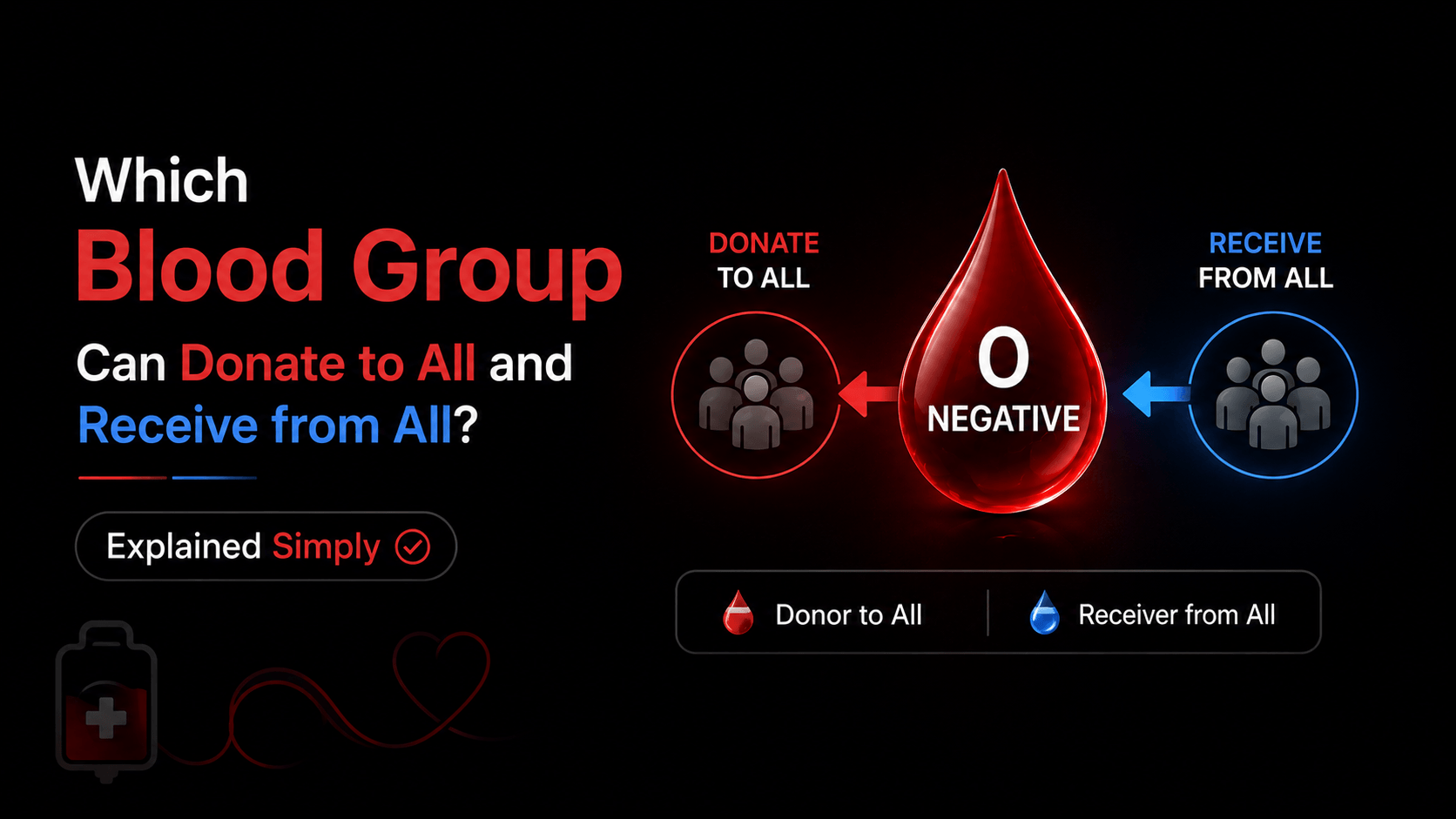
Universal Blood Donor and Recipient: Blood Group Compatibility Chart
O negative (O−) red blood cells are commonly considered the universal donor type, while AB positive (AB+) is considered the universal recipient for red blood cells. However, “universal donor” does not mean that every blood component can be given to every person. Hospitals still perform blood typing and compatibility testing whenever possible to make transfusions as safe as possible.
Understanding your blood group can be especially important during emergencies, blood transfusions, surgery, pregnancy and blood donation.
In this guide, we explain which blood group can donate to everyone, which blood group can receive from everyone, how blood type compatibility works, why O negative is important, and what AB positive means.
If you're new to blood groups, you can also read our complete guide:
Blood Groups Explained: Types, Compatibility, Diet & Health Guide
Quick Answer: Who Is the Universal Blood Donor and Recipient?
| Question | Answer |
|---|---|
| Universal donor for red blood cells | O negative (O−) |
| Universal recipient for red blood cells | AB positive (AB+) |
| O negative can receive red blood cells from | O negative |
| AB positive can receive red blood cells from | All major ABO/Rh blood types |
| Best practice during transfusion | Use compatible, type-specific blood whenever possible |
The terms universal donor and universal recipient generally refer to red blood cell transfusions. Plasma and other blood components follow different compatibility rules.
What Is a Blood Group?
A blood group is a classification of blood based mainly on specific antigens, or markers, found on the surface of red blood cells.
The main ABO blood groups are:
-
A
-
B
-
AB
-
O
Each blood group can also be either:
-
Positive (+)
-
Negative (−)
This creates the eight major ABO/Rh blood types:
-
A+
-
A−
-
B+
-
B−
-
AB+
-
AB−
-
O+
-
O−
These blood types matter because receiving incompatible red blood cells can cause an immune reaction and serious complications.
How Do ABO and Rh Blood Types Work?
The two most familiar parts of a blood type are the ABO system and the Rh system.
The ABO Blood Group System
The ABO system is based on whether red blood cells carry A antigen, B antigen, both, or neither.
-
Type A has A antigen.
-
Type B has B antigen.
-
Type AB has both A and B antigens.
-
Type O has neither A nor B antigen.
The Rh Blood Group System
The positive or negative part of your blood type usually refers to the RhD antigen.
-
Rh-positive (+) means the RhD antigen is present.
-
Rh-negative (−) means the RhD antigen is absent.
For example:
A+ means blood group A with RhD present.
O− means blood group O with RhD absent.
This ABO and Rh combination is the basis of the common eight blood types used in blood compatibility charts.
What Is the Universal Donor Blood Group?
O Negative Is the Universal Donor for Red Blood Cells
O negative (O−) is commonly called the universal donor blood type for red blood cells.
O-negative red blood cells do not have A, B or RhD antigens on their surface. Because of this, they can be used for many recipients when compatible blood is not yet available.
This is particularly important in emergency situations when doctors may need to begin a red blood cell transfusion before the patient's exact blood type has been established.
However, the phrase “universal donor” should not be interpreted to mean that O-negative blood is suitable for every blood component or every transfusion situation. Hospitals use blood typing, antibody screening and crossmatching whenever possible.
Why Is O Negative Important in Emergencies?
Imagine a patient arriving at an emergency department after a serious accident with significant blood loss.
Doctors may need to begin treatment quickly while the patient's blood type is still being determined.
In these situations, O-negative red blood cells may be used according to clinical protocols because they are compatible with the ABO/Rh systems of many recipients.
Once the patient's blood type and compatibility information are available, healthcare professionals can select the most appropriate blood product.
This is one reason why O-negative blood donors are particularly valuable for emergency blood supplies.
What Is the Universal Recipient Blood Group?
AB Positive Is the Universal Recipient for Red Blood Cells
AB positive (AB+) is commonly called the universal recipient blood type for red blood cells.
A person with AB-positive blood has A and B antigens and is Rh-positive. Under the standard ABO/Rh system, AB-positive recipients can receive red blood cells from all eight major blood types, provided the transfusion is appropriately tested and clinically indicated.
This is why AB+ is commonly described as the universal recipient.
However, being a universal recipient does not mean that AB-positive patients never need blood matching.
Healthcare professionals still perform appropriate testing before transfusion whenever circumstances allow.
Blood Group Compatibility Chart
The following chart shows the standard ABO/Rh red blood cell compatibility for the eight major blood types.
| Blood Group | Can Donate Red Blood Cells To | Can Receive Red Blood Cells From |
|---|---|---|
| O− | O−, O+, A−, A+, B−, B+, AB−, AB+ | O− |
| O+ | O+, A+, B+, AB+ | O+, O− |
| A− | A−, A+, AB−, AB+ | A−, O− |
| A+ | A+, AB+ | A+, A−, O+, O− |
| B− | B−, B+, AB−, AB+ | B−, O− |
| B+ | B+, AB+ | B+, B−, O+, O− |
| AB− | AB−, AB+ | AB−, A−, B−, O− |
| AB+ | AB+ | All eight major ABO/Rh blood types |
Important: This is a simplified red blood cell compatibility chart. Real transfusions can involve additional blood-group antigens, antibodies, testing and clinical considerations.
Who Can Donate Blood to Whom?
If you are trying to understand the donor side of blood compatibility, this simplified guide can help:
O Negative
O-negative red blood cells can generally be given to recipients across the major ABO/Rh groups.
O Positive
O-positive red blood cells can generally be given to people who are Rh-positive, including O+, A+, B+ and AB+.
A Negative
A-negative red blood cells can generally be given to A−, A+, AB− and AB+ recipients.
A Positive
A-positive red blood cells can generally be given to A+ and AB+ recipients.
B Negative
B-negative red blood cells can generally be given to B−, B+, AB− and AB+ recipients.
B Positive
B-positive red blood cells can generally be given to B+ and AB+ recipients.
AB Negative
AB-negative red blood cells can generally be given to AB− and AB+ recipients.
AB Positive
AB-positive red blood cells can generally be given to AB+ recipients.
Why Does Blood Compatibility Matter?
Blood transfusion is not simply a matter of putting one person's blood into another person's bloodstream.
If incompatible red blood cells are transfused, the recipient's immune system can recognize them as foreign and may attack them.
A serious incompatible transfusion reaction can cause complications such as:
-
Fever
-
Chills
-
Breathing difficulties
-
Low blood pressure
-
Kidney problems
-
Severe transfusion reactions
-
Other potentially serious complications
This is why healthcare professionals carefully check blood groups and perform compatibility testing before transfusion whenever possible.
The exact testing process can vary depending on the clinical situation and the type of blood product being transfused.
When Is O-Negative Blood Used in Emergencies?
O-negative red blood cells can be particularly important when there is an urgent need for blood and the patient's blood type is not yet known.
Examples can include:
Major Trauma
Patients with severe bleeding after accidents may need rapid blood replacement.
Emergency Surgery
Some emergency procedures require immediate access to blood products.
Unknown Blood Type
If there is not enough time to complete blood typing before treatment is required, emergency protocols may involve O-negative red blood cells.
Once the patient's blood type is known, healthcare professionals can select compatible blood based on the patient's clinical needs.
Why Is O Negative Blood Important?
O-negative blood is relatively uncommon compared with some other blood types, yet O-negative red blood cells are particularly useful in emergencies.
This creates an important need for eligible O-negative blood donors.
However, every blood group is valuable. Blood banks need different blood types because patients require compatible blood products based on their blood type and medical circumstances.
If you know your blood group and are eligible to donate, consider contacting an authorized blood donation center to learn whether and when you can donate.
Can O Negative Receive Blood From Everyone?
No.
This is one of the most common misunderstandings about universal donors.
Although O-negative red blood cells can be used for many recipients, a person with O-negative blood generally receives O-negative red blood cells under the standard ABO/Rh compatibility system.
The reason is related to the antibodies and antigens involved in ABO/Rh compatibility.
In actual medical practice, transfusion decisions may also involve other blood-group antigens and antibody testing.
Can O Positive Be a Universal Donor?
No.
O-positive blood is not a universal donor type because it is Rh-positive.
O-positive red blood cells can generally be given to:
-
O+
-
A+
-
B+
-
AB+
They are not generally used for Rh-negative recipients when compatible Rh-negative blood is available.
Is AB Positive the Best Blood Group?
No blood group is inherently “better” than another.
AB-positive blood has an advantage when it comes to receiving compatible red blood cells because AB+ recipients can receive red blood cells from all eight major ABO/Rh blood types.
O-negative blood has an important advantage for emergency red blood cell donation because it can be used for many recipients.
But every blood type has an important role in the healthcare system.
Does Blood Group Compatibility Matter During Pregnancy?
Blood group compatibility can also be relevant during pregnancy, particularly when considering the Rh factor.
For example, an Rh-negative pregnant person carrying an Rh-positive fetus may require medical monitoring and preventive treatment when clinically indicated.
This is different from the standard question of whether one person's blood can be transfused into another person.
Pregnancy-related blood group issues should always be discussed with an obstetrician or other qualified healthcare professional.
If you are pregnant and have questions about your Rh status, speak with your healthcare provider rather than relying only on an online blood compatibility chart.
How Can You Find Out Your Blood Group?
If you don't know your blood type, the most reliable approach is to have it determined through an appropriate blood typing test.
You may be able to find your blood group through:
-
A blood typing test at a clinic or laboratory
-
Blood donation testing, where applicable
-
Previous medical records, if your blood type has already been documented
A standard blood typing test can identify your ABO and Rh blood group.
If you are unsure of your blood type, don't assume it based on family history or other information. Confirm it through appropriate testing.
You can also read our guide on:
How to Find Out Your Blood Group at Home or Through Testing
Can Blood Group Change Naturally?
For most people, their ABO and Rh blood group remains the same throughout life.
Rare medical situations, such as certain illnesses or treatments, can affect how blood group results are interpreted or detected.
If you ever receive conflicting blood group results, discuss them with a healthcare professional and have the blood type confirmed through appropriate laboratory testing.
Common Myths About Universal Donors and Recipients
Myth 1: O Negative Is the “Best” Blood Group
Not true.
O-negative blood is particularly useful for emergency red blood cell transfusions, but every blood group is important.
Myth 2: AB Positive People Never Need Blood Matching
Wrong.
Even AB-positive recipients require appropriate blood testing and compatibility procedures before transfusion whenever possible.
Myth 3: O Negative Can Receive Blood From Everyone
No.
Under the standard ABO/Rh red-cell compatibility system, O-negative recipients generally receive O-negative red blood cells.
Myth 4: O Positive Is a Universal Donor
No.
O-positive red blood cells can generally be donated to Rh-positive recipients, but they are not a universal donor type.
Myth 5: Blood Groups Change Easily
Usually no.
Your ABO/Rh blood group generally remains the same throughout your life, although rare medical situations can complicate blood typing.
Blood Donation in India: Why Every Blood Group Matters
Blood donation can help maintain supplies for patients who need transfusions because of accidents, surgery, medical conditions and other emergencies.
It is particularly important to maintain adequate supplies of less common blood types, but common blood types are also continuously needed.
If you are considering donating blood, contact an authorized blood bank or blood donation organization and ask about eligibility requirements, donation intervals and current needs.
Never delay emergency medical treatment while trying to arrange a blood donation yourself. In an emergency, contact the appropriate healthcare facility or emergency service.
Frequently Asked Questions
Which blood group is the universal donor?
O negative (O−) is commonly considered the universal donor type for red blood cells. It is particularly important in emergency situations when the patient's blood type is not yet known.
Which blood group is the universal recipient?
AB positive (AB+) is commonly considered the universal recipient for red blood cells because AB+ recipients can receive red blood cells from all eight major ABO/Rh blood types, subject to appropriate testing.
Is O negative a universal donor?
O-negative red blood cells are commonly called the universal donor type because they lack A, B and RhD antigens. However, the term applies specifically to red blood cell compatibility and does not mean that every blood component is universally compatible.
Is O positive also a universal donor?
No. O-positive red blood cells can generally be donated to O+, A+, B+ and AB+ recipients, but they are not considered universally compatible with Rh-negative recipients.
Can O negative receive blood from O positive?
Under the standard ABO/Rh red blood cell compatibility system, O-negative recipients generally receive O-negative red blood cells, not O-positive red blood cells.
Can AB positive receive blood from every blood group?
AB-positive recipients can generally receive red blood cells from all eight major ABO/Rh blood types. Appropriate blood testing and compatibility procedures are still required.
What is the rarest blood group in India?
The Bombay blood group (hh phenotype) is an extremely rare blood type and has been reported in India. It is different from the standard ABO blood groups and can create special transfusion requirements.
You can read our guide on:
The Bombay Blood Group and Rare Blood Types in India
Can blood group affect health?
Research has identified associations between certain blood groups and some health conditions, but these associations do not mean that having a particular blood type will cause a disease. Lifestyle, genetics, environment and many other factors also influence health.
Does blood group compatibility matter during pregnancy?
Yes. The Rh factor can be important during pregnancy, particularly when an Rh-negative mother carries an Rh-positive fetus. Healthcare professionals can test and monitor this when appropriate.
Can you find your blood group without a blood test?
The reliable way to confirm your ABO and Rh blood type is through appropriate blood typing. Do not rely on symptoms, appearance, family assumptions or unverified home methods to determine your blood group.
Key Takeaway
The two terms to remember are:
O negative (O−): Universal donor for red blood cells
AB positive (AB+): Universal recipient for red blood cells
But these terms are simplified descriptions of ABO/Rh red blood cell compatibility. In real healthcare settings, blood typing, antibody screening, crossmatching and clinical judgment are important for safe transfusion.
Knowing your blood group can be useful, especially during medical emergencies, but a blood group should always be confirmed through appropriate testing.
If you are eligible to donate blood, consider contacting an authorized blood donation center to learn how you can help maintain the blood supply.
Medical Sources
For this article, consult authoritative medical and public-health sources such as:
-
World Health Organization (WHO) — Blood safety and availability
-
American Society of Hematology (ASH) — Blood safety and matching
-
Mayo Clinic — Universal blood donor type
-
American Red Cross — Blood types and compatibility
Medical disclaimer: This article is intended for general educational purposes and does not replace medical advice, diagnosis or treatment. Blood transfusions and pregnancy-related blood group concerns should always be managed by qualified healthcare professionals.
Written by: Sehat Raaz Editorial Team
Suggested Articles
 Fitness
Unbreakable Joints: 5 Gentle Strength Routines That Restore & Protect Your Body (2026 Guide)
Learn 5 gentle strength routines designed to support joint health, improve mobility, and build strength while keeping...
Read Article arrow_forward Fitness
I Bought the $3,000 Fitness Suit That Electrocutes You. I’m Sending It Back
Is a $3,000 EMS fitness suit worth it? Discover my experience using electrical muscle stimulation, its benefits and d...
Read Article arrow_forward Ayurvedic Tips
Emma Raducanu: Wimbledon fitness concerns grow as British No 1 cuts short practice session
Concerns are mounting over Emma Raducanu's fitness for Wimbledon after the British No 1 reportedly cut short a practi...
Read Article arrow_forward Healthy Lifestyle
The Longevity Code: 8 Unspoken Cellular Health Markers You Need to leverage for True Anti-Aging
Explore 8 overlooked cellular health markers linked to aging and longevity, and learn practical strategies to support...
Read Article arrow_forward