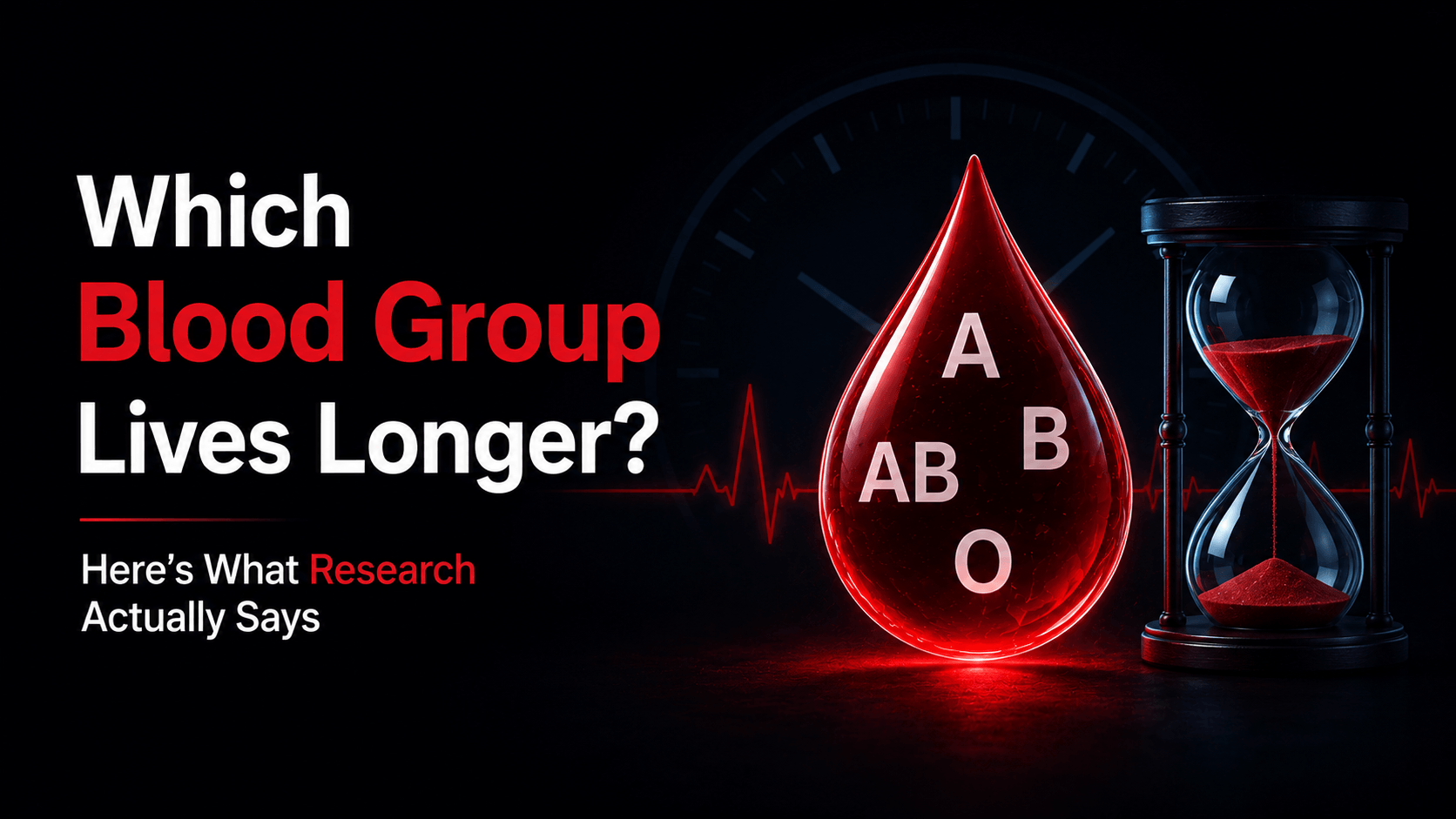
Everyone wants to live longer. Better sleep, cleaner diet, more steps on the fitness tracker. But what if part of the answer was already written in your blood before you were even born?
It sounds a little dramatic. But researchers have spent decades studying whether your ABO blood type has any connection to how long you live, and the findings are genuinely surprising.
This isn't about fortune-telling. It's about understanding patterns and using that knowledge to make smarter choices for your health. So let's get into it.
Does Blood Type Really Affect Life Expectancy?
Short answer: it can play a role, but it's one factor among many.
No researcher will tell you that blood type alone determines whether you live to 65 or 95. Life expectancy is shaped by genetics, lifestyle, environment, access to healthcare, diet, and stress levels. Blood type sits somewhere in that complex mix.
But here's what's interesting. Large population studies involving hundreds of thousands of people across multiple countries — have found consistent patterns linking ABO blood groups to rates of heart disease, cancer, cognitive decline, and certain infections. And those conditions are among the leading causes of death worldwide.
So while your blood type isn't a death sentence or a longevity guarantee, understanding the research can help you know where to focus your preventive health efforts.
Blood Group O: The Longevity Leader (With Some Caveats)
If you're looking for which blood group research most consistently associates with longer life, type O tends to come out ahead.
Here's why.
Lower Heart Disease Risk
Heart disease is the number one killer globally. And multiple studies have found that people with blood type O have a significantly lower risk of developing cardiovascular disease compared to types A, B, and AB.
A landmark meta-analysis published in the European Journal of Epidemiology found that non-O blood types (A, B, and AB) had a 9% higher risk of coronary artery disease and a 15% higher risk of heart attack compared to type O individuals.
Researchers believe this links to clotting behavior. Type O individuals tend to have lower levels of von Willebrand factor, a clotting protein. Higher von Willebrand factor levels in other blood types are associated with increased clot formation, which can block arteries and trigger heart attacks or strokes.
Less clotting risk generally means a healthier heart over a lifetime. And a healthier heart is one of the strongest predictors of a longer life.
Lower Risk of Certain Cancers
Some studies also show that type O individuals have lower rates of pancreatic cancer and stomach cancer compared to type A. These are aggressive cancers with high mortality rates, so even a modest reduction in risk matters in terms of longevity outcomes.
The Trade-Off: Ulcers and Infections
Type O isn't completely in the clear. These individuals show higher rates of peptic ulcers, largely because of a stronger tendency toward H. pylori colonization in the stomach. They also show some vulnerability to certain bacterial infections like cholera.
But ulcers, while painful and serious, are treatable. Heart disease and pancreatic cancer are far harder to survive. In the overall longevity equation, type O's advantages tend to outweigh its vulnerabilities.
Blood Group A: Longer History, But More Health Vulnerabilities
Type A is one of the older blood mutations in human evolution. In many parts of the world, particularly in Europe and South Asia, it's one of the most common blood types.
But when it comes to longevity research, type A faces some real challenges.
Higher Heart Disease and Stroke Risk
Type A individuals have higher levels of LDL cholesterol on average and tend to show greater clotting tendencies than type O. Studies have linked type A to elevated risk of deep vein thrombosis (blood clots in the legs) and pulmonary embolism (clots in the lungs) — both potentially fatal conditions.
Cancer Risk
Research consistently links type A to higher rates of stomach cancer, particularly in populations where H. pylori infection is common. The interaction between type A antigens and H. pylori appears to increase cellular damage risk in the stomach lining over time.
Type A has also been associated with slightly elevated risk of pancreatic cancer, which carries one of the lowest survival rates of any cancer type.
COVID-19 and Respiratory Disease
During the COVID-19 pandemic, studies across multiple countries found that type A individuals were more likely to experience severe illness and complications. For a virus that has now caused millions of deaths globally, this is a meaningful longevity-related finding.
If you want a detailed breakdown of how each blood group responds differently to diseases, the Blood Group and Disease Risk: What Science Actually Says guide covers this in depth.
Blood Group B: Moderate Risk Profile
Type B sits in a middle ground for most longevity research. It doesn't carry the same strong cardiovascular protection as type O, but it also doesn't face the elevated cancer and clotting risks linked to type A.
Some studies have found a modest association between type B and higher risk of ovarian cancer and pancreatic cancer, but the effect sizes are small.
One area where type B stands out is in immune diversity. Type B individuals produce antibodies against A antigens, giving them broader cross-protection against some infections than type AB. In populations historically exposed to a wide range of pathogens, this may have provided a survival advantage.
Blood Group AB: The Most Complex Longevity Profile
AB is the newest blood type evolutionarily and the rarest. It's also the blood type that tends to face the most longevity challenges in research.
Cardiovascular and Clotting Risk
Type AB individuals have high levels of both von Willebrand factor and Factor VIII clotting protein. This creates a higher baseline risk for blood clots, heart attacks, and strokes. Studies have found AB individuals face roughly 23% higher risk of heart disease compared to type O.
Cognitive Decline
A study from the University of Vermont found that people with AB blood type were 82% more likely to develop cognitive impairment and memory problems as they aged, compared to other blood types. The study tracked thousands of older adults and found consistent patterns even after adjusting for other risk factors.
Since cognitive decline and dementia are major contributors to reduced quality of life and earlier death in older populations, this finding is significant.
The Upside for AB
AB individuals do benefit from immune tolerance. They don't produce antibodies against A or B antigens, so they're less prone to certain autoimmune overreactions. They're also universal recipients for blood transfusions, which matters in medical emergencies.
But in terms of population-level longevity research, AB tends to rank lower than O and even B on key health indicators.
Longevity by Blood Type: A Research Summary
|
Blood Group |
Heart Disease Risk |
Cancer Risk |
Cognitive Risk |
Overall Longevity Research |
|
O |
Lowest |
Lower (some cancers) |
Moderate |
Most favorable |
|
A |
Elevated |
Higher (stomach, pancreatic) |
Moderate |
Below O |
|
B |
Moderate |
Slightly elevated |
Lower |
Middle ground |
|
AB |
Highest |
Moderate |
Highest |
Most challenges |
This is a general picture based on population research. Individual variation is enormous.
Which Blood Group Lives Longer: What Researchers Conclude
If you pull together the major studies on blood type and mortality, a pattern emerges. Type O individuals, on average, face lower rates of the conditions most likely to shorten life, particularly heart disease and certain cancers.
Type AB individuals, on average, face the highest rates of cardiovascular and cognitive risk factors associated with early death.
But here's what every researcher in this field will tell you: lifestyle matters more than blood type. A lot more.
A person with type AB who exercises regularly, eats a heart-healthy diet, manages stress, and gets routine health screenings will likely outlive a sedentary type O who smokes and eats poorly.
Blood type is a risk modifier, not a destiny.
For a complete overview of blood type health including compatibility, diet myths, and what research says about each type, the Blood Groups Explained: Types, Compatibility, Diet, Health and Myths (2026 Guide) is a good starting point.
How to Use Your Blood Type Knowledge Practically
Knowing your blood type and its associated risks isn't cause for panic. It's just useful information like knowing your family history of diabetes or heart disease. Here's how to act on it.
If you're Type O: You have a natural cardiovascular edge. Don't waste it. Maintain a diet rich in anti-inflammatory foods, get regular exercise, and watch for signs of peptic ulcer disease (burning stomach pain, especially on an empty stomach).
If you're Type A: Prioritize heart health early. Monitor your LDL cholesterol and blood pressure regularly. Reduce processed foods and sodium. Stay on top of cancer screenings, especially for stomach health. Manage stress, since cortisol appears to have a stronger inflammatory effect in type A individuals.
If you're Type B: Get regular health screenings, maintain a varied and balanced diet, and stay physically active. Your risk profile is moderate, but that doesn't mean complacency.
If you're Type AB: Take cardiovascular health very seriously. Follow a heart-protective diet (Mediterranean-style diets are well-researched). Stay mentally active reading, learning new skills, and social connection all support cognitive resilience. Get blood pressure and cholesterol checked annually.
Understanding your blood type is also part of knowing your complete health picture. If you haven't confirmed yours yet, the How to Check Your Blood Group at Home Without a Test guide walks you through your options.
FAQs
Q: Which blood group has the longest life expectancy?
Research most consistently associates blood type O with lower rates of heart disease, certain cancers, and blood clotting disorders the conditions most likely to shorten life. But lifestyle factors have a far greater influence on lifespan than blood type alone.
Q: Is blood type AB bad for longevity?
AB individuals face higher cardiovascular risk and greater susceptibility to cognitive decline compared to other blood types. But with proactive health management, AB individuals absolutely can and do live long, healthy lives.
Q: Does blood type O really live longer?
Studies suggest type O has statistically lower rates of the major killers — heart disease, some cancers, and clotting events. This gives type O a statistical edge in longevity research, but it's not a guarantee of long life.
Q: Which blood type has the highest risk of heart disease?
Type AB tends to show the highest cardiovascular risk in research, followed by type A and type B. Type O shows the lowest risk.
Q: Can I do anything to extend my life regardless of blood type?
Yes, absolutely. Exercise regularly, eat a diet rich in whole foods, don't smoke, limit alcohol, manage chronic stress, sleep 7 to 8 hours a night, and get regular health screenings. These habits override blood type risk factors in almost every study.
Q: Does Rh factor (positive or negative) affect longevity?
Current research does not show a significant connection between Rh factor and life expectancy. The ABO group has far more documented health associations than the Rh factor.
The Bottom Line
Your blood type gives researchers a window into certain health tendencies. Type O tends to fare best in longevity research, largely because of its lower cardiovascular risk. Type AB tends to face the most challenges. Types A and B fall somewhere in the middle.
But none of this is fixed. The choices you make every single day what you eat, how much you move, how well you sleep, whether you go to your doctor or keep putting it off shape your lifespan far more than your ABO type ever will.
Know your blood group. Understand the risks. Then do something about them.
Disclaimer: This article is for informational and educational purposes only. It is not a substitute for professional medical advice, diagnosis, or treatment. Always consult a qualified healthcare provider for personalized health guidance.
Suggested Articles
 Ayurvedic Tips
Ayurvedic Tips
Ayurvedic Tips
 Diet Plans
Blood Group Diet Chart for Weight Loss — Vegetarian Guide
A practical vegetarian blood group diet chart for weight loss. Find out which foods help or harm each blood type and ...
Read Article arrow_forward
Ayurvedic Tips