
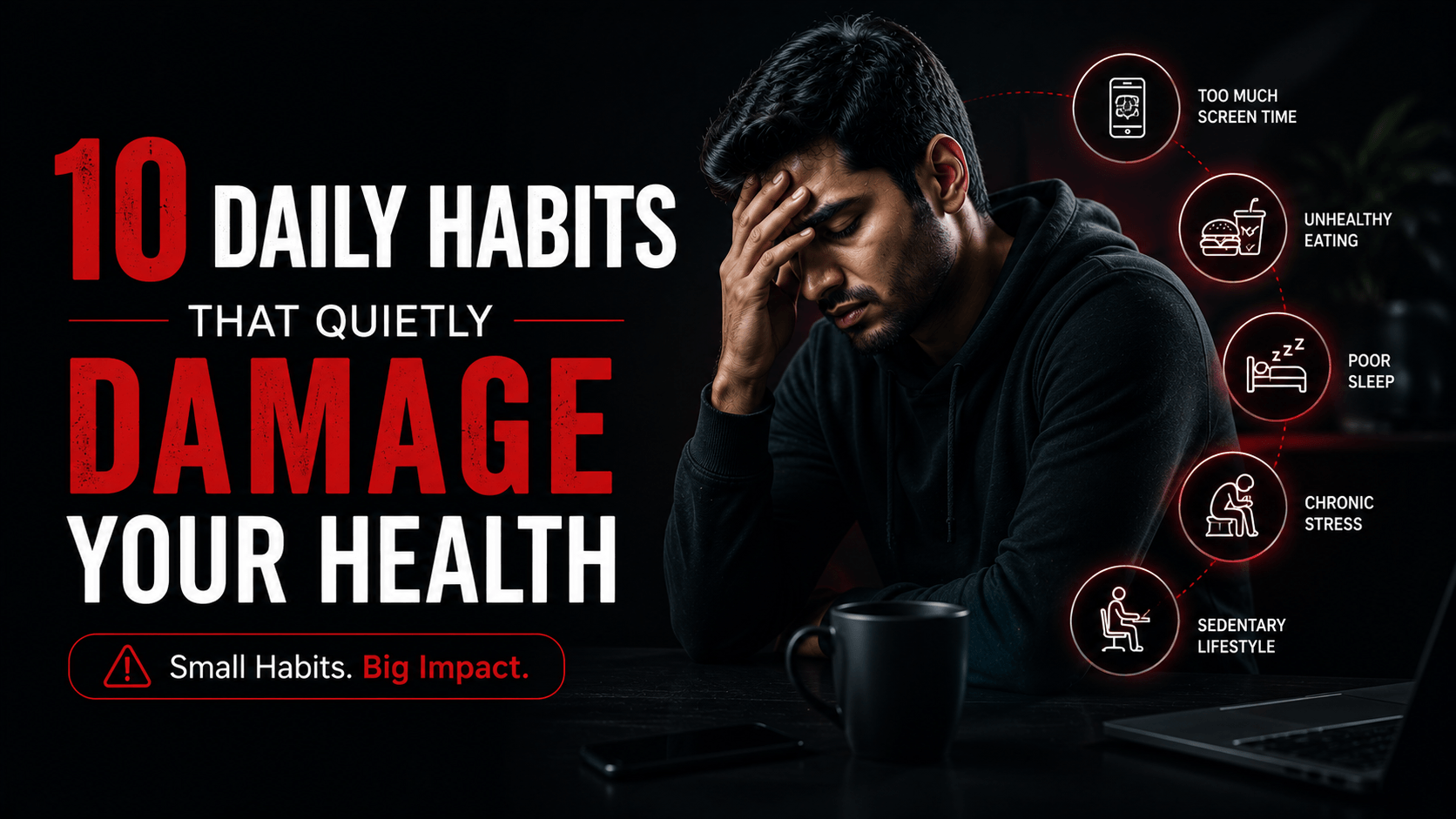
How Small Daily Habits Can Lead to Serious Health Problems
Nobody wakes up and decides to ruin their health. It happens slowly, through small choices that feel harmless in the moment.
One late night turns into five. One skipped meal becomes the norm. You tell yourself you'll fix the posture, drink more water, sleep earlier next week, next month, when things slow down.
But here's the uncomfortable truth. Your body doesn't wait for things to slow down. It responds to what you do every single day. And some of the habits most people consider totally fine are quietly building up real damage.
This isn't a lecture. It's a list of things to actually look at, understand, and fix one at a time.
1. Sitting for Most of the Day
You might go to the gym three times a week and still be hurting your health by sitting for 9 to 10 hours a day. Research has established that prolonged sitting is an independent risk factor for heart disease, type 2 diabetes, obesity, and even certain cancers — regardless of how much you exercise outside of work hours.
When you sit for hours without movement, circulation slows, blood sugar regulation becomes less efficient, and your metabolism essentially idles. Over years, this contributes to arterial stiffness, weight gain around the abdomen, and increased systemic inflammation.
The fix is not complicated. Stand up every 45 to 60 minutes. Take a short walk after meals. Use a standing desk for part of your workday if possible. These micro-breaks add up to significant protection over a lifetime.
2. Chronic Sleep Deprivation
Sleeping 5 to 6 hours and feeling "fine" is one of the most dangerous lies the modern lifestyle tells you. Sleep deprivation doesn't just make you tired it is one of the most consistent predictors of serious long-term health problems.
Short sleep is linked to higher rates of hypertension, diabetes, cardiovascular disease, obesity, weakened immunity, depression, and cognitive decline. The European Heart Journal found that people sleeping under 6 hours regularly have significantly higher rates of heart attacks.
The brain clears toxic waste products during deep sleep. The cardiovascular system repairs itself. Hormones regulating appetite and stress reset. None of that happens adequately on 5 hours.
Most adults need 7 to 8 hours. Not in bed actually sleeping. If you're consistently getting less, treat it as the health issue it genuinely is.
3. Ignoring Chronic Dehydration
Most people are mildly dehydrated for most of the day and don't know it. Thirst is actually a late signal — by the time you feel thirsty, your body has already been under-hydrated for a while.
Mild chronic dehydration affects concentration, energy levels, kidney function, digestion, and skin health. It also contributes to headaches that people routinely blame on stress or screens.
Over time, inadequate water intake increases the risk of kidney stones, urinary tract infections, and impaired metabolic function. In hot Indian summers, the risk compounds significantly.
The goal is roughly 2.5 to 3 litres of water a day for most adults, more in summer or with physical activity. Starting the day with a glass of water before coffee is a simple habit that makes a real difference.
4. Eating Ultra-Processed Foods Most Days
This is where a lot of people get defensive, because ultra-processed food is everywhere and it tastes good. But the data on what it does to the body is not pretty.
Ultra-processed foods packaged snacks, instant noodles, biscuits, sugary drinks, delivery meals heavy in refined oils — are designed to be eaten quickly and in large amounts. They're high in sodium, sugar, trans fats, and artificial additives, and low in everything your body actually needs.
Regular consumption drives up LDL cholesterol, promotes chronic inflammation, disrupts gut microbiome balance, spikes and crashes blood sugar, and contributes to weight gain in a way that whole foods simply don't.
The fix doesn't require cooking elaborate meals. Replacing two or three ultra-processed eating occasions a week with whole food alternatives dal and rice, a fruit, boiled eggs, homemade roti with sabzi makes a measurable difference to health markers over months.
5. Skipping Meals (Especially Breakfast)
Skipping meals feels like discipline. In reality, it often triggers the opposite of what people want.
When you skip a meal particularly breakfast blood sugar drops, cortisol rises, and hunger compounds. Most people who skip meals end up overeating later, choosing poorer quality food because they're hungry and in a hurry, and disrupting the metabolic rhythm that keeps blood sugar and insulin stable.
Chronically skipping meals also signals the body to slow metabolism and preserve fat, which is counter-productive for weight management.
This doesn't mean everyone needs a traditional breakfast at 7 AM. But going 5 to 6+ hours between eating occasions regularly creates a blood sugar rollercoaster that stresses the metabolic system over time.
6. Spending Hours on Screens Before Bed
The hour or two before sleep is biologically designed to wind down. Blue light from phones, tablets, and laptops interferes directly with melatonin production the hormone that signals the brain it's time to sleep.
Beyond the light itself, the psychological stimulation of social media, news, or even work emails keeps the nervous system activated when it should be decompressing. The result is difficulty falling asleep, reduced sleep quality even when sleep does happen, and a brain that enters the next day already running at a deficit.
This is one of the most common unhealthy daily habits in urban India right now. And it's particularly damaging because it undermines sleep which as mentioned above, has knock-on effects across nearly every system in the body.
The practical fix: no screens 45 to 60 minutes before bed. Read a physical book, do some light stretching, or simply sit without a device. It feels difficult the first few nights and then becomes genuinely easy.
7. Poor Posture During Work and Phone Use
If you work at a desk or spend significant time on your phone, you are almost certainly doing damage to your spine, neck, and shoulders that you won't fully feel for another 5 to 10 years.
Slouching at a desk compresses the lower spine, strains the muscles around the neck and shoulders, and reduces lung capacity by restricting the chest. "Tech neck" the forward head posture from looking down at a phone places up to 27 kilograms of force on the cervical spine when the head tilts forward at a 60-degree angle.
Chronic poor posture contributes to persistent back pain, tension headaches, reduced mobility as you age, and in severe cases, nerve compression. Most people don't connect their regular headaches or neck stiffness to posture until significant damage has accumulated.
Simple corrections: adjust your screen to eye level, take posture breaks every hour, and do basic neck and back stretches daily. A lumbar support cushion for your chair costs between INR 500 and INR 1,500 and is genuinely worth it.
8. Using Stress as a Badge of Honor
Indian professional culture has developed a troubling relationship with busyness and stress. Being overwhelmed is treated as proof of ambition. "I'll rest when this project is done" is said so often it's become a cliche.
But chronic stress is not a motivational state. It is a physiological emergency. Sustained elevated cortisol damages artery walls, suppresses immune function, disrupts sleep, promotes abdominal fat storage, impairs memory and decision-making, and significantly increases the risk of cardiovascular disease.
Research on why heart attacks are rising among young Indians consistently identifies chronic stress as a primary contributor. It's not soft. It's biochemistry.
Managing stress is a health intervention as real as any medication. Exercise, adequate sleep, setting work boundaries, therapy, meditation, and genuine social connection all reduce cortisol. Treating this seriously could extend your life.
For context on how chronic stress interacts with cardiovascular health and which individuals carry additional baseline risk, the Why Young Indians Are Facing More Heart Attacks Than Before article covers the full picture.
9. Never Getting Routine Health Checkups
If nothing is visibly wrong, most people don't go to the doctor. This is one of the most consequential silent health risks in India's urban population.
High cholesterol doesn't hurt. High blood pressure rarely causes noticeable symptoms before a serious event. Early-stage diabetes feels like nothing for years. These conditions are building damage quietly in the background, and without routine screening, there is no way to know.
A basic annual health checkup lipid profile, fasting blood sugar, blood pressure, and a blood count costs between INR 800 and INR 2,500 at most private diagnostic labs in India. Government hospitals provide most of these at significantly lower cost or free for eligible patients.
For anyone who wants to understand how their blood type adds another layer to their personal health risk profile, the Blood Group and Disease Risk Chart Explained is a data-driven read that connects blood group to specific disease tendencies — useful context for building a preventive health routine.
10. Social Isolation and Neglecting Relationships
This one is easy to overlook in a list of health habits because it doesn't look like a habit. But chronic loneliness and weak social connection have measurable biological effects.
Research has found that social isolation increases the risk of premature death by up to 26%, comparable to smoking 15 cigarettes a day. Loneliness elevates cortisol, disrupts sleep, increases inflammatory markers, and is associated with higher rates of depression, anxiety, and cardiovascular disease.
Young professionals who have relocated to a new city for work, or who spend most of their social energy online rather than in real-world relationships, are at particular risk of this quiet form of health damage.
Genuine human connection having meals with people you care about, maintaining friendships, being part of a community is not a luxury. It's a health behavior with documented outcomes.
Summary: 10 Habits and Their Silent Damage
|
Unhealthy Daily Habit |
What It Damages |
Simple Fix |
|
Prolonged sitting |
Heart, metabolism, blood sugar |
Stand/move every hour |
|
Under 6 hours sleep |
Heart, immunity, brain |
Target 7 to 8 hours |
|
Chronic dehydration |
Kidneys, concentration, skin |
2.5 to 3L water daily |
|
Ultra-processed diet |
Cholesterol, gut, inflammation |
Replace 2 to 3 meals/week |
|
Skipping meals |
Blood sugar, metabolism |
Eat regular, balanced meals |
|
Late-night screens |
Sleep quality, melatonin |
No screens 45 min before bed |
|
Poor posture |
Spine, neck, headaches |
Eye-level screens, posture breaks |
|
Chronic stress |
Heart, immunity, brain |
Boundaries, exercise, therapy |
|
No health checkups |
Silent chronic disease |
Annual basic screening |
|
Social isolation |
Heart, mental health, longevity |
Invest in real relationships |
FAQs
Q: What are the most common unhealthy daily habits that damage health?
Prolonged sitting, poor sleep, chronic dehydration, eating ultra-processed food regularly, late-night screen use, and skipping health checkups are among the most common and most damaging daily habits especially because none of them feel dangerous in the moment.
Q: Can sitting too much really cause health problems?
Yes. Research classifies prolonged sitting as an independent risk factor for heart disease, type 2 diabetes, and metabolic issues even in people who exercise regularly. Breaking up sitting with movement every hour significantly reduces the risk.
Q: How does lack of sleep damage health?
Chronic sleep deprivation affects nearly every body system it raises blood pressure, weakens immunity, impairs blood sugar regulation, promotes weight gain, increases cardiovascular risk, and accelerates cognitive decline. Most adults need 7 to 8 hours of actual sleep.
Q: Is skipping breakfast really that bad for you?
Regularly skipping meals disrupts blood sugar regulation, elevates cortisol, and often leads to overeating later in the day. It's not about breakfast specifically it's about going long hours between eating in ways that stress the metabolic system.
Q: How do I know if my daily habits are hurting my health?
Routine health checkups are the most reliable way to catch damage before it becomes serious. A basic lipid profile, blood sugar test, and blood pressure check can reveal hidden issues that daily habits have been silently building.
Q: What is the single worst daily habit for long-term health?
Sleep deprivation is arguably the most systemically damaging because it compounds every other risk it makes stress worse, cravings for junk food higher, exercise harder, and directly damages cardiovascular and cognitive health on its own.
Q: Can stress actually cause physical health problems?
Yes. Chronic stress elevates cortisol, which damages artery walls, suppresses immunity, disrupts sleep, promotes fat storage, and significantly raises cardiovascular disease risk. It is a direct physiological threat, not just a mental state.
The Bottom Line
None of these habits are complicated. None of them require you to overhaul your entire life at once. But left unchecked, they compound each one making the others a little worse, and the body a little more vulnerable.
The good news is that most of them are fully reversible. Sleep more, move more, eat better, drink more water, put down the phone before bed, get a checkup. Small changes, done consistently, undo a surprising amount of quiet damage.
Pick one habit from this list today. Just one. Fix it this week. Then move to the next one.
Your future self will be grateful you started now.
Disclaimer: This article is for informational and educational purposes only and does not constitute medical advice. Always consult a qualified healthcare professional for guidance specific to your health situation.
Suggested Articles
 Fitness
How eight years of gym consistency changed my body
See how eight years of consistent gym training transformed strength, muscle, body composition, recovery, mental resil...
Read Article arrow_forward Ayurvedic Tips
Ayurvedic Tips
Ayurvedic Tips
World Cup 2026: England's Reece James and Declan Rice to have fitness assessed
Read Article arrow_forward
Ayurvedic Tips
Les Mills, the Fitness Pioneer Who Changed Millions of Workouts, Has Died at 91.
Legendary fitness pioneer Les Mills, whose innovative workout programs transformed global fitness, has passed away at...
Read Article arrow_forward