
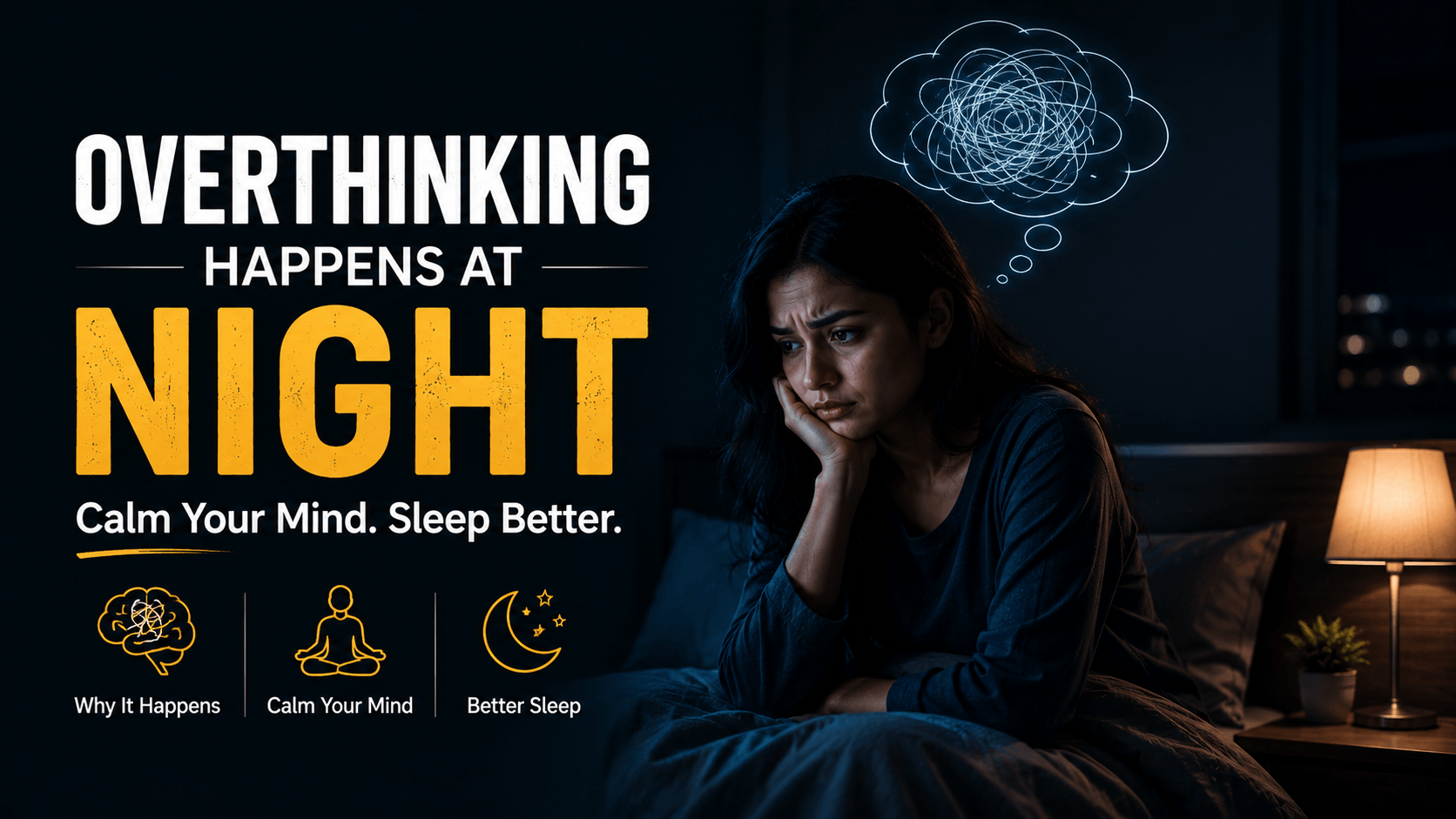
The Science Behind Overthinking Before Bed and How to Stop It
It's 1 AM. You should be asleep. Instead, you're mentally replaying a conversation from three days ago, writing an imaginary resignation letter, worrying about a bill you forgot to pay, and also somehow thinking about something embarrassing you said in 2017.
Sound familiar?
You're not alone. Millions of people lie in bed every night with a brain that simply refuses to switch off. The quiet that should bring rest instead brings a flood of thoughts some practical, some anxious, some that make no logical sense at midnight.
The strange thing is that you probably didn't feel this way during the day. You were busy, distracted, moving. But the moment your head hit the pillow, your mind came alive.
There's a real reason for that. And once you understand why overthinking at night happens, the solutions become a lot clearer.
Why Does Overthinking Get Worse at Night?
This isn't a character flaw or a sign of weakness. It's biology, and it happens to almost everyone to some degree.
The Brain's Default Mode Network Switches On
During the day, your brain is occupied with tasks, conversations, stimulation. External demands give the mind a direction to focus on. But at night, when the distractions disappear and the room goes dark and quiet, the brain shifts into what neuroscientists call the Default Mode Network (DMN) the system that activates during rest and turns attention inward.
The DMN is the brain doing self-referential processing. It reviews the past, projects into the future, thinks about relationships, and evaluates your place in the world. In moderate amounts, this is healthy and useful. But for people carrying unprocessed stress, unresolved anxiety, or chronic worry, the DMN can go into overdrive. The result is racing thoughts, rumination, and the kind of anxious thinking that keeps you staring at the ceiling at 1 AM.
Cortisol and the Stress Carry-Over Effect
Cortisol, the primary stress hormone, normally follows a rhythm — high in the morning to wake you up, dropping through the day, lowest at night. But chronic stress disrupts this pattern. When cortisol remains elevated into the evening, the nervous system stays in a low-level alert state even when the body is physically tired.
This is why high-stress days almost always lead to worse nights. The stress you didn't process during the day doesn't disappear when you lie down. It surfaces.
No Input Means No Competition for Attention
The brain can only process so much at once. During the day, sensory input, social interaction, and task demands compete for attention. Anxious thoughts exist but get crowded out.
At night, there's nothing competing. The worried thought has the floor all to itself. This is why anxiety at night often feels more intense than daytime anxiety, even when the underlying concern is the same. The silence amplifies it.
Phones Make It Significantly Worse
Most people scroll their phone right before sleep. This is a triple threat to nighttime mental calm.
Blue light from screens suppresses melatonin (the sleep hormone). Social media and news content stimulate emotional responses — comparison, outrage, anxiety, FOMO. And the habit of constant input throughout the day trains the brain to expect stimulation, making the transition to stillness feel uncomfortable rather than restful.
The phone habit doesn't just delay sleep. It actively primes the brain for anxious, active thinking at exactly the wrong moment.
What Overthinking at Night Actually Does to Your Health
This isn't just a sleep quality issue, though it's definitely that. Chronic nighttime overthinking is a sustained health problem.
Poor sleep caused by racing thoughts is linked to higher rates of depression, anxiety disorders, cardiovascular disease, weakened immunity, and metabolic dysfunction. When the brain doesn't get adequate restorative sleep night after night, cognitive function declines, emotional regulation worsens, and stress tolerance drops.
Which creates a cycle. Worse sleep makes you more emotionally reactive during the day. More emotional reactivity creates more unprocessed stress. More unprocessed stress means worse nights. It compounds.
Breaking the cycle requires understanding what's driving the overthinking and then actively intervening with the right techniques.
The connection between sleep deprivation and serious long-term health consequences is covered in detail in the 10 Daily Habits That Quietly Damage Your Health article, which puts sleep health in the broader context of daily habits that accumulate into real physical risk.
How to Stop Overthinking at Night: What Actually Works
There's a lot of advice out there about this. Some of it is useful. Some of it is the equivalent of telling someone with a broken leg to walk it off. Here's what is actually supported by psychology and sleep science.
1. Schedule a "Worry Time" Earlier in the Day
This sounds counterintuitive, but it's one of the most evidence-backed techniques from cognitive behavioral therapy for insomnia (CBT-I).
Instead of trying to suppress anxious thoughts at night which usually makes them stronger set aside 15 to 20 minutes earlier in the evening (not right before bed) as a dedicated time to think about worries, concerns, and unresolved situations.
Write them down. Identify which ones you can act on tomorrow. Acknowledge the ones you can't control. Then, when those thoughts surface at 11 PM, your brain has a reference: "I've already dealt with this. It's on the list." This genuinely reduces the urgency the brain assigns to those thoughts at bedtime.
2. Write It Down Before You Sleep - The Brain Dump
The reason the brain keeps revisiting problems at night is partly because it doesn't trust that they'll be remembered or addressed. Writing them down transfers the "holding" function from the brain to paper, which signals to the nervous system that it can let go.
Keep a notebook by your bed. Before sleeping, write down:
-
Anything unfinished or worrying
-
What you need to do tomorrow
-
Any thought that keeps circling
It doesn't have to be structured or eloquent. The act of externalizing thoughts reduces the brain's need to keep cycling them. Research published in the Journal of Experimental Psychology found that students who wrote a to-do list before bed fell asleep significantly faster than those who didn't.
3. Box Breathing to Calm the Nervous System
When anxiety at night is physical heart rate up, chest tight, mind racing the fastest intervention is a breathing technique that directly activates the parasympathetic nervous system (the rest and digest system that counters the fight or flight response).
Box breathing is simple and effective:
-
Inhale slowly for 4 counts
-
Hold for 4 counts
-
Exhale slowly for 4 counts
-
Hold for 4 counts
-
Repeat 4 to 6 cycles
This technique is used by military personnel, athletes, and therapists precisely because it has measurable physiological effects. It lowers heart rate, reduces cortisol, and shifts the nervous system out of alert mode within a few minutes.
4. The 4-7-8 Breathing Technique for Sleep
Developed by Dr. Andrew Weil as a natural sedative technique, 4-7-8 breathing is slightly more potent than box breathing for sleep specifically.
-
Exhale completely through the mouth
-
Inhale quietly through the nose for 4 counts
-
Hold the breath for 7 counts
-
Exhale completely through the mouth for 8 counts
-
Repeat 3 to 4 cycles
The extended exhale activates the vagus nerve, which directly slows heart rate and tells the brain the body is safe. Most people notice a shift within 2 to 3 cycles.
5. Cut Screen Time 45 to 60 Minutes Before Bed Seriously
This appears on almost every sleep hygiene list, and people ignore it because scrolling feels relaxing. It isn't.
The melatonin suppression from blue light delays sleep onset by 1 to 2 hours in research settings. But more relevant to overthinking is the psychological priming effect. Social media activates social comparison, news activates threat monitoring, and even entertainment activates emotional engagement all states that are the opposite of calm.
Replace screens with anything that doesn't require a decision or emotional engagement: a physical book, light stretching, a warm shower, or simply sitting quietly. The first few nights feel uncomfortable. Within a week, the brain adapts and the pre-sleep routine becomes genuinely calming.
6. Body Scan Meditation to Move Out of the Head
When the mind is spinning, one of the most effective techniques is to deliberately redirect attention to the body. A body scan meditation does this systematically.
Lying in bed, close your eyes and bring awareness slowly from your feet upward noticing the feeling in your toes, your feet, your calves, your knees. Just noticing, without judgment. Move gradually upward through the body.
This works because the brain cannot fully focus on anxiety and physical sensation simultaneously. Moving attention to the body interrupts the rumination loop and anchors awareness in the present moment rather than imagined future scenarios or replayed past events.
Guided body scan meditations are available free on apps like Insight Timer and YouTube, and cost nothing to try.
7. Lower the Room Temperature
This is a practical one many people overlook. The body needs to drop its core temperature slightly to initiate and maintain sleep. A room that's too warm common in Indian summers, even with a fan keeps the body in a mildly alert state.
Ideal sleep temperature is between 18 and 22 degrees Celsius. If an AC is available, setting it between 20 and 22 degrees creates significantly better sleep conditions. If not, a table fan directed at the body, cooling the feet (which help regulate body temperature), and lightweight cotton bedding all help.
8. Build a Consistent Wind-Down Routine
The brain is highly responsive to pattern and cue. If you do the same sequence of calming activities every night before sleep, the brain begins to associate that sequence with sleep essentially training a relaxation response.
A simple wind-down routine might look like:
-
9:30 PM: Phone goes on do not disturb and face-down
-
9:30 to 9:45 PM: Light stretching or yoga nidra
-
9:45 to 10:00 PM: Warm shower or wash face
-
10:00 to 10:20 PM: Physical book reading
-
10:20 PM: Lights off, 4-7-8 breathing
The specific activities matter less than their consistency. After 2 to 3 weeks of following the same sequence, the routine itself begins to trigger drowsiness.
9. Address What the Overthinking Is Actually About
Sometimes nighttime overthinking is a symptom, not the problem. If the same themes keep surfacing night after night a relationship, a work situation, a decision, financial pressure the brain is trying to process something that hasn't been addressed during the day.
In these cases, relaxation techniques help in the short term, but they're not the real solution. The real solution is engaging with the underlying issue through journaling, an honest conversation, therapy, or a concrete decision and action plan.
Chronic anxiety at night that doesn't respond to sleep hygiene and relaxation techniques may benefit from talking to a mental health professional. In India, access to therapy has improved significantly — many platforms now offer online sessions starting from INR 500 to INR 1,500 per session, making it accessible without the time cost of in-person visits.
10. Watch What You Eat and Drink in the Evening
Caffeine has a half-life of 5 to 6 hours. A cup of chai at 5 PM still has half its caffeine active at 11 PM. For people who are sensitive to caffeine, even afternoon tea can delay sleep onset and increase nighttime arousal.
Heavy meals close to bedtime activate the digestive system, raise body temperature, and can cause acid reflux that disrupts sleep. Alcohol, despite making people feel sleepy initially, fragments sleep and suppresses REM sleep the stage most critical for emotional processing.
For better nights: no caffeine after 3 PM, a lighter dinner at least 2 hours before sleep, and limiting alcohol, particularly on nights when good sleep matters most.
Techniques Summary: Which to Use When
|
Situation |
Best Technique |
|
Mind racing with worries |
Brain dump journaling + worry time scheduling |
|
Physical anxiety (tight chest, fast heart rate) |
Box breathing or 4-7-8 breathing |
|
Can't stop replaying events |
Body scan meditation |
|
General restlessness and inability to wind down |
Consistent wind-down routine + no screens |
|
Same worries every night |
Address the underlying issue (therapy/journaling/action) |
|
Hot room disrupting sleep |
Temperature control (AC at 20 to 22 degrees) |
|
Caffeine sensitivity |
Cut off chai and coffee by 3 PM |
FAQs
Q: Why do I only overthink at night and not during the day?
During the day, external tasks and distractions compete with anxious thoughts. At night, when those distractions disappear, the brain's Default Mode Network activates and turns attention inward. With no competition for attention, worried thoughts feel much louder.
Q: Is nighttime overthinking a sign of anxiety disorder?
Not necessarily. Most people experience occasional nighttime overthinking. But if it happens most nights, significantly disrupts sleep, and causes distress or functional impairment, it may indicate generalized anxiety disorder or insomnia disorder. A mental health professional can help clarify this.
Q: What is the fastest way to stop overthinking at night?
Box breathing or 4-7-8 breathing provides the fastest physiological intervention typically reducing heart rate and nervous system activation within 3 to 5 minutes. For thought-based rumination, brain dump journaling before bed reduces the urgency the brain assigns to unresolved concerns.
Q: Does anxiety at night affect physical health?
Yes. Chronic sleep disruption from nighttime anxiety is linked to higher rates of cardiovascular disease, weakened immunity, metabolic dysfunction, depression, and cognitive decline. It's not just a sleep quality issue it's a physical health issue.
Q: How long does it take for wind-down routines to work?
Most people notice improvement within 1 to 2 weeks of consistent practice. The brain needs repetition to associate a new routine with sleep. Don't judge it after 2 to 3 nights give it at least 2 weeks.
Q: Can exercise help with overthinking at night?
Yes, significantly. Regular moderate exercise reduces cortisol, lowers baseline anxiety, and improves sleep quality. However, intense exercise within 2 hours of bedtime can raise cortisol and body temperature, making it harder to sleep. Morning or afternoon exercise is ideal for sleep benefits.
Q: Does overthinking affect the heart?
Chronic overthinking keeps the nervous system in a low-level stress state, which over time elevates cortisol, raises blood pressure, and increases cardiovascular risk. This is one of the pathways through which chronic stress contributes to heart disease explored in more detail in the Why Young Indians Are Facing More Heart Attacks Than Before article.
The Bottom Line
Your brain is not broken. It's doing exactly what it's designed to do process, review, protect. It just doesn't know when to stop.
Nighttime overthinking happens because the quiet removes every distraction that kept anxious thoughts at bay during the day. The biology is clear. The solutions are real. And unlike a lot of health advice, most of them cost nothing and can be tried tonight.
Start with the brain dump. Try box breathing the next time you're lying awake at 1 AM. Put your phone down 45 minutes before bed for one week and notice what changes.
A calmer night starts with a few deliberate choices before you ever close your eyes.
Disclaimer: This article is for informational and educational purposes only and does not constitute medical advice. If you are experiencing persistent anxiety, sleep disorders, or mental health concerns, please consult a qualified healthcare professional or licensed therapist.
Suggested Articles
 Ayurvedic Tips
World Cup 2026: England's Reece James and Declan Rice to have fitness assessed
Read Article arrow_forward
Ayurvedic Tips
 Healthcare News
How to Check Your Blood Group at Home Without a Test (And When You Really Should See a Doctor)
Discover simple, practical ways to find out your blood group at home without a formal lab test, including home kits, ...
Read Article arrow_forward Women’s Health
Blood Group Compatibility Chart for Pregnancy - What Every Couple Needs to Know
Worried about blood group compatibility in pregnancy? Learn about Rh factor risks, ABO matching, and what every coupl...
Read Article arrow_forward