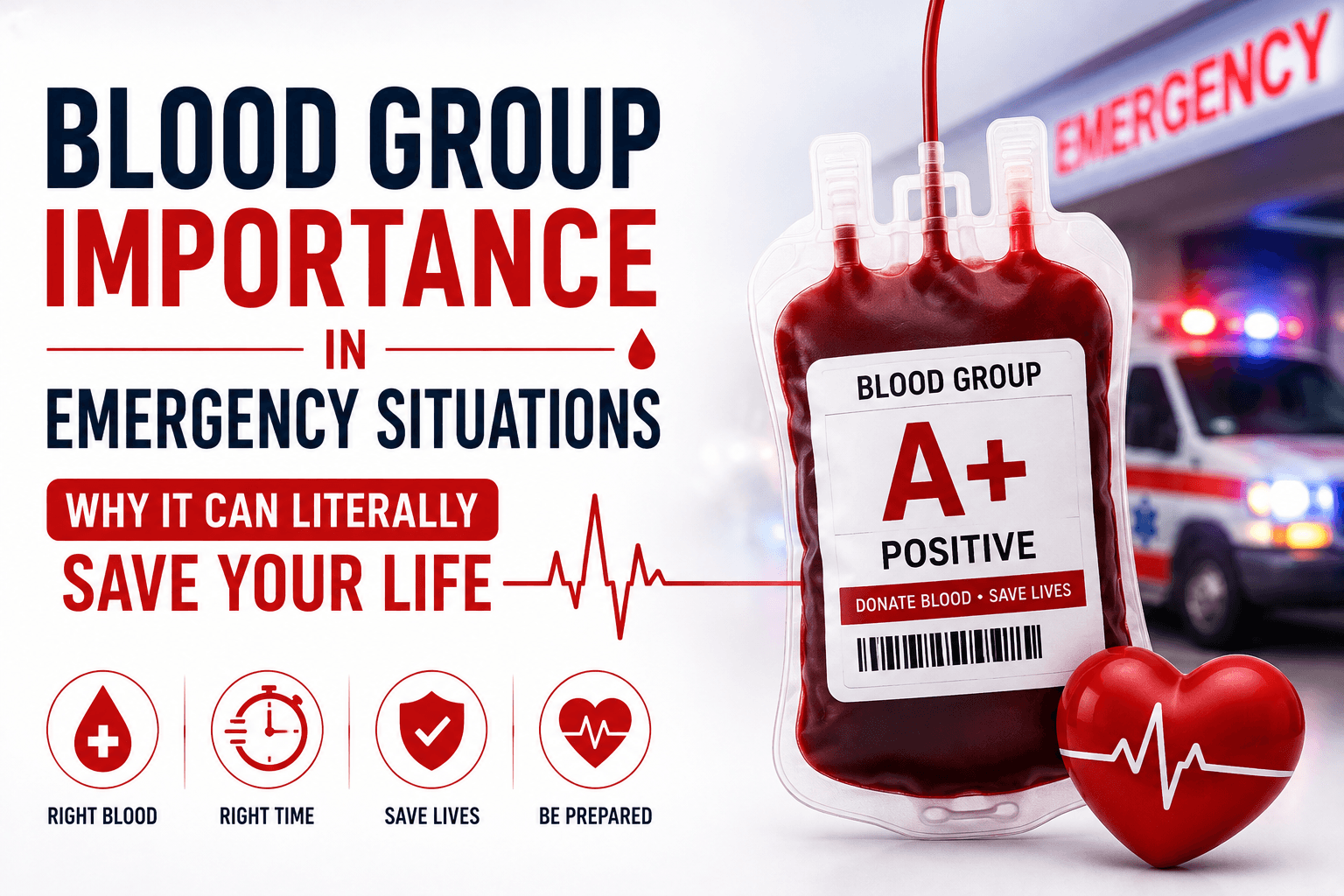
Blood Group Importance in Emergency Situations: Why It Can Literally Save Your Life
Picture this. A road accident. Someone is rushed to the hospital unconscious, bleeding heavily. The doctors need to give blood immediately. There's no time to wait for a full crossmatch test. Every minute counts.
In that moment, one small piece of information can mean the difference between survival and a fatal transfusion reaction. That piece of information is the patient's blood group.
This isn't a hypothetical. It happens in emergency rooms across India and the world every single day. And the scary part is that most people walking around right now don't have their blood group written anywhere on their person not in their wallet, not on their phone, not on any ID.
This article explains exactly why your blood group is critical in emergencies, what happens when it's unknown or mismatched, and what you can do right now to make sure you or someone you love is protected.
Why Blood Group Matters More in Emergencies Than in Everyday Life
In regular life, your blood group mostly stays in the background. You might mention it at a clinic, write it on a form, or look it up out of curiosity. It doesn't feel urgent.
But emergencies change everything.
When someone loses significant blood from trauma, surgery, internal bleeding, or childbirth complications the body cannot survive without replacement blood. And replacement blood is not one-size-fits-all. Give the wrong blood type and the patient's immune system goes to war against the transfused cells. That reaction, called a hemolytic transfusion reaction, can cause kidney failure, shock, and death within minutes.
This is why blood group compatibility is one of the most critical checks in emergency medicine. And it's why knowing your blood type before an emergency happens is genuinely important.
What Happens When You Receive the Wrong Blood Type
Your blood cells carry specific antigens proteins that act like identity tags. Your immune system recognizes your own antigens as safe and treats anything else as a threat.
When you receive incompatible blood, your immune system launches an immediate attack on the foreign cells. This causes:
-
Rapid destruction of the transfused red blood cells (hemolysis)
-
Release of toxic substances into the bloodstream
-
Severe drop in blood pressure
-
Kidney failure from the overload of cell debris
-
Fever, chills, and back pain
-
In severe cases - cardiac arrest and death
This kind of reaction can start within minutes of receiving the wrong blood. It is one of the most serious medical errors that can occur in a hospital setting, and it is almost entirely preventable with proper blood typing and crossmatching.
Blood Group Compatibility in Emergency Transfusions: A Quick Reference
Most of the time, hospitals run a type and crossmatch test before transfusion this confirms the patient's exact blood type and checks compatibility with the donor unit. But in trauma emergencies, there isn't always time.
Here's a basic compatibility overview that emergency teams work with:
|
Blood Type |
Can Receive From |
Can Donate To |
|
A+ |
A+, A-, O+, O- |
A+, AB+ |
|
A- |
A-, O- |
A+, A-, AB+, AB- |
|
B+ |
B+, B-, O+, O- |
B+, AB+ |
|
B- |
B-, O- |
B+, B-, AB+, AB- |
|
AB+ |
All blood types |
AB+ only |
|
AB- |
A-, B-, O-, AB- |
AB+, AB- |
|
O+ |
O+, O- |
A+, B+, AB+, O+ |
|
O- |
O- only |
All blood types |
The last row is the one emergency doctors care about most. O negative is the universal donor — it can be given to anyone regardless of their blood type. This is why O negative blood is the most precious blood in any hospital's emergency supply.
Why O Negative Blood Is the Most Critical in Emergencies
When a trauma patient arrives unconscious and there is no time to run a blood type test, doctors reach for O negative blood. It is the safe default because it lacks the A, B, and Rh antigens that trigger immune reactions.
O negative blood is used in:
-
Mass casualty incidents (accidents, natural disasters)
-
Trauma bays when blood type is unknown
-
Newborn transfusions (infants can react to many blood types)
-
Emergency surgeries before crossmatch results return
The problem? O negative is rare. Only about 7 to 8% of people globally have this blood type, and in India it's even rarer — approximately 2 to 4% of the population. Blood banks constantly face shortages of O negative blood because the demand in emergencies is always high.
This is why O negative donors are urgently needed and why hospitals actively recruit them. If you're O negative, your blood literally saves lives in ways no other type can.
For a deeper look at how universal donor and universal recipient blood types work in practice, the Which Blood Group Can Donate to All and Receive from All? guide explains the full picture clearly.
Emergency Situations Where Blood Group Becomes Critical
Blood group importance in emergency situations goes beyond road accidents. Here are the key scenarios where knowing your blood type or a patient's blood type becomes urgent:
1. Road Traffic Accidents and Trauma
India reports among the highest road accident fatalities in the world. When accident victims arrive at trauma centers with severe blood loss, immediate transfusion is often required. Time spent identifying the blood type is time the patient doesn't have.
2. Emergency Surgery
Planned surgeries have time for proper pre-operative blood typing. Emergency surgeries appendix rupture, internal bleeding, emergency C-sections often do not. Having the blood type already on record or on the patient's ID speeds up the process significantly.
3. Childbirth Emergencies
Postpartum hemorrhage (excessive bleeding after delivery) is one of the leading causes of maternal death in India. When it happens suddenly, rapid blood transfusion is critical. An Rh negative mother in this situation also needs Rh-compatible blood immediately.
4. Natural Disasters and Mass Casualties
During floods, earthquakes, or building collapses, hospitals receive large numbers of patients simultaneously. Blood banks are stretched thin. Triage teams work faster when patients have their blood type documented somewhere accessible.
5. Medical Emergencies in Remote Areas
In rural India, sophisticated crossmatch testing may not be available at the nearest medical facility. Local health workers and first responders rely on the patient's known blood type to make faster, safer transfusion decisions.
The Real Cost of Not Knowing Your Blood Type
Most people think "I'll figure it out if something happens." But in a true emergency, that thinking costs precious time.
A full crossmatch test takes 45 to 60 minutes. An abbreviated crossmatch takes about 10 minutes. Neither is possible when a patient is in immediate danger. Even a rapid blood type test takes 5 to 10 minutes that the patient may not have.
Knowing your blood type and having it documented means:
-
Doctors can confirm your type faster instead of starting from scratch
-
Emergency teams can act without waiting for results
-
Your family can tell medical staff what they need to know if you can't speak
-
Blood bank staff can pull the right unit faster
It's a small piece of information with a potentially massive impact.
Should Your Blood Group Be on Your ID Card?
In many countries, it already is. In France, for example, the blood type used to appear on national ID cards. Several countries include it in military dog tags. Some Indian state governments have explored including blood group on driving licences and Aadhaar cards.
In India, including your blood group when you apply for or renew your driving licence is a common recommendation by health authorities and road safety organizations. It's a straightforward step that costs nothing and could save your life.
You can also:
-
Write your blood group on the back of your phone case
-
Add it to your phone's medical ID (both iPhone and Android support this)
-
Keep a small card in your wallet with your blood type and emergency contact
-
Make sure your family members know your blood type
If you're not sure what your blood type is, confirming it now is easy and inexpensive. The How to Check Your Blood Group at Home Without a Test article walks through your options, including home kits and simple lab tests available at most diagnostic centers across India for under INR 200.
Blood Donation: The Other Side of the Emergency Equation
Here's something worth thinking about. Every unit of blood used in an emergency came from a donor. Blood cannot be manufactured in a lab it has to come from real people who gave it willingly.
In India, voluntary blood donation rates are still below what the healthcare system needs. The National Blood Transfusion Council estimates India requires about 15 million units of blood per year, and availability often falls short especially for rare blood types like O negative and AB negative.
Donating blood is one of the most direct ways to contribute to emergency preparedness in your community. You don't need a special skill or training. You just need to be healthy and willing.
Understanding which blood types are most in demand and how compatibility works helps donors make more informed decisions. The Blood Groups Explained: Types, Compatibility, Diet, Health and Myths (2026 Guide) is a solid read if you want to understand the full landscape of blood group science.
Steps to Take Right Now: Emergency Preparedness for Your Blood Type
Here's a simple action plan anyone can follow:
Step 1: Find out your blood group if you don't already know it. Visit any diagnostic lab. A basic blood group test in India costs between INR 50 and INR 200. Results come in under an hour.
Step 2: Document it everywhere it matters. Add it to your phone's medical ID. Write it on your driving licence if you have space. Keep a small card in your wallet.
Step 3: Tell your immediate family. Make sure your spouse, parents, or children know your blood type. In an emergency where you're unconscious, they become your voice.
Step 4: If you're a rare type (O-, AB-, B-), register with a blood bank. Many hospitals and blood banks maintain donor registries for rare blood types. Getting registered means they can contact you when supplies run low and you'll know you're making a real difference.
Step 5: Consider donating blood. Most adults in good health can donate every 3 months. It takes about 30 to 45 minutes and the blood you give could save up to 3 lives.
Blood Group Quick Reference Card for Emergencies
|
Blood Type |
Universal? |
Most Critical In Emergency |
Notes |
|
O- |
Universal donor |
YES — used when type unknown |
Always in short supply |
|
O+ |
Donate to all Rh+ |
High demand |
Most common type globally |
|
AB+ |
Universal recipient |
Moderate |
Can receive any blood |
|
AB- |
Rare universal recipient |
High |
Rarest major blood type |
|
A-, B- |
Rh negative types |
Moderate |
Needed for Rh- patients |
FAQs
Q: Why is blood group important in an emergency?
In emergencies like accidents, trauma, or sudden surgery, patients often need immediate blood transfusions. Giving the wrong blood type triggers a severe immune reaction that can cause kidney failure, shock, and death. Knowing the patient's blood type allows doctors to act faster and safer.
Q: Which blood group is most useful in emergencies?
O negative is the most critical because it can be given to any patient regardless of their blood type. It's the universal donor blood used when there is no time to determine the patient's type.
Q: What happens if you get the wrong blood type in a transfusion?
The immune system attacks the foreign blood cells, causing hemolysis (destruction of red blood cells), release of toxic substances, kidney failure, dangerous drop in blood pressure, and potentially death. This is called a hemolytic transfusion reaction.
Q: Should I carry my blood group information with me?
Yes. Adding your blood type to your phone's medical ID, carrying a wallet card, or having it on your driving licence can save critical time in an emergency when you may not be able to speak for yourself.
Q: How do I find out my blood group?
A basic blood group test at any diagnostic lab in India costs between INR 50 and INR 200. Results are typically available within the same visit. Some home testing kits are also available online.
Q: Which blood group is hardest to find in an emergency?
O negative, AB negative, and B negative are among the rarest blood types and are most often in short supply at blood banks. O negative is especially critical because of its universal donor status and high emergency demand.
Q: Can I add my blood type to my Aadhaar or driving licence in India?
Some states and transport authorities allow blood group information on driving licences. It is recommended to check with your regional transport office. You can also add it manually to physical cards you carry.
The Bottom Line
Your blood group is a piece of medical information that usually sits quietly in the background of your life. Until the day it isn't.
Road accidents, surgical emergencies, childbirth complications, mass casualty events all of these can create a situation where your blood type becomes the most important thing a doctor needs to know, and needs to know fast.
Knowing your blood group, documenting it properly, and making sure your family knows it too is one of the easiest, lowest-cost steps you can take to protect yourself in a crisis. It takes 30 minutes and costs almost nothing.
Do it today. Not because something bad will definitely happen. But because if it does, you'll already be one step ahead.
Disclaimer: This article is for informational and educational purposes only and does not constitute medical advice. Always consult a qualified healthcare professional for medical guidance specific to your situation.
Suggested Articles
 Ayurvedic Tips
Anxiety Breakthrough: 7 Instant Home Remedies to Calm Panic
Feeling overwhelmed by anxiety or panic attacks? Discover 7 instant home remedies to calm panic and reclaim control o...
Read Article arrow_forward
Ayurvedic Tips
Strength Training for Seniors: Essential Equipment Guide
Discover the crucial equipment seniors need to start strength training, promoting comfortable aging and improved fitn...
Read Article arrow_forward Diet Plans
Blood Group Diet Chart for Weight Loss — Vegetarian Guide
A practical vegetarian blood group diet chart for weight loss. Find out which foods help or harm each blood type and ...
Read Article arrow_forward
Ayurvedic Tips
Reclaim Your Rest: 7 Ancient Ayurvedic Practices for Deep Sleep
Struggling to sleep? Discover 7 ancient Ayurvedic practices to help you achieve deep, serene sleep tonight. Improve y...
Read Article arrow_forward